

 Go Back Menu




 Close
Close
What Is a Pharmaceutical Company? A Complete Guide to How Pharmaceutical Companies Develop, Manufacture, and Deliver Medicines



A pharmaceutical company is an organisation engaged in the research, development, manufacturing, and distribution of medicines and healthcare products intended to prevent, diagnose, or treat disease. From aspirin to advanced biologics, every pharma company operates at the intersection of science, regulation, and public health, translating laboratory discoveries into products that reach patients safely and affordably.
Understanding what pharmaceutical companies do — and how they do it — offers valuable insight into one of the world’s most complex and highly regulated industries. This guide breaks down the core functions of a pharma company, the journey a medicine takes from discovery to distribution, and how leading players such as Mankind Pharma exemplify this process in practice.
The Role of a Pharmaceutical Company
At its core, a pharmaceutical company performs four interconnected functions:
- Research and Development (R&D): Identifying disease targets, discovering molecules, and testing them through preclinical and clinical trials.
- Manufacturing: Producing medicines at scale under strict quality and safety standards.
- Regulatory Compliance: Securing approvals from national and international health authorities before a drug can be sold.
- Distribution and Marketing: Ensuring medicines reach hospitals, pharmacies, and patients through robust supply chains.
Pharmaceutical companies generally fall into a few broad categories: innovator or research-based companies that develop new molecules, generic drug manufacturers that produce affordable versions of off-patent medicines, and companies that combine both prescription formulations with over-the-counter (OTC) consumer healthcare products. Many large players, including Indian pharma companies, operate across all three categories simultaneously.
How Pharmaceutical Companies Develop Medicines
Drug development is notoriously long, expensive, and uncertain. According to the International Federation of Pharmaceutical Manufacturers & Associations (IFPMA), only a very small fraction of compounds investigated in laboratories ultimately reach the market. Industry estimates suggest that approximately one in ten drug candidates entering clinical development eventually receives marketing approval.
This risk-intensive model explains why pharmaceutical companies are among the most research-heavy businesses in the world. Industry-wide R&D investment reached an estimated $260 billion in 2025, representing roughly 16% of total industry revenue — one of the highest research-intensity ratios of any global sector.
Companies like Mankind Pharma, one of India’s leading pharmaceutical companies, illustrate how this translates into real-world impact. Mankind operates through 7 dedicated R&D facilities supported by more than 730 scientists, and in 2019 became the first Indian company — and only the second globally — to develop and launch Dydrogesterone, a therapy used in high-risk pregnancies and infertility treatment. This kind of investment allows a domestically focused pharma company to move beyond generics into original formulation development.
How Pharmaceutical Companies Manufacture Medicines
While manufacturing process development and validation begin during drug development, commercial-scale manufacturing typically commences after regulatory approval is granted. Manufacturing begins under Good Manufacturing Practice (GMP) standards enforced by agencies such as India’s CDSCO, the US FDA, and the European Medicines Agency. Manufacturing facilities must maintain rigorous quality controls covering raw material sourcing, production hygiene, batch testing, and packaging integrity.
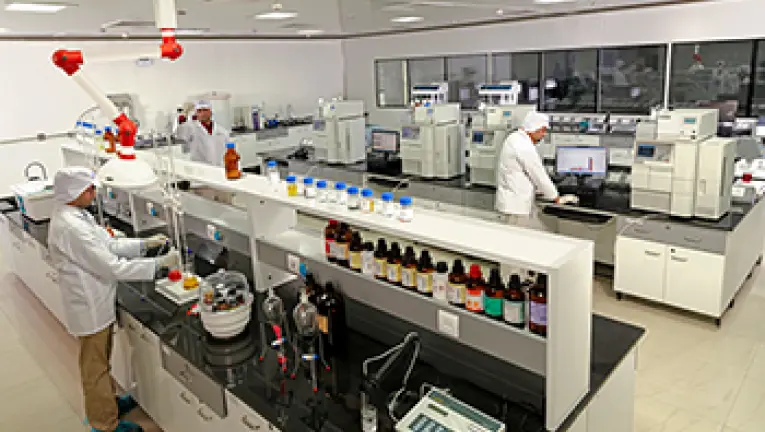
Mankind Pharma’s manufacturing footprint reflects the scale required to serve a market as large as India’s. The company operates 32 manufacturing facilities across 8 locations, producing a wide range of dosage forms, including tablets, capsules, syrups, vials, ampoules, blow-fill-seal products, soft and hard gels, eye drops, creams, and contraceptives. The facilities have been certified by national and international organisations, reflecting the global quality benchmarks that regulated-market-facing Indian pharma companies must meet.
Manufacturing at this scale is not limited to finished formulations. Many pharmaceutical companies also produce Active Pharmaceutical Ingredients (APIs) — the core chemical compounds that give a medicine its therapeutic effect — to enhance supply-chain resilience, strengthen quality oversight, reduce dependency on external suppliers, and improve operational efficiency .
How Pharmaceutical Companies Deliver Medicines
Delivering medicines to patients requires more than manufacturing capability; it demands an extensive distribution network capable of reaching both urban centres and remote rural areas. This is a particularly acute challenge in a country like India, where more than half the population resides in villages, making consistent access to medicines difficult.
Mankind Pharma has addressed this through a company-owned distribution setup designed to strengthen last-mile accessibility. The company has built a presence across 40-plus international markets spanning Asia, Africa, South-East Asia, the Gulf, and CIS countries, in addition to its dominant position in India, where it derives the majority of its revenue and ranks as the fourth-largest pharmaceutical company by domestic sales.
Beyond prescription medicines, many pharmaceutical companies also maintain strong consumer healthcare portfolios to widen accessibility through the OTC segment. Mankind’s Manforce, Prega News, and Unwanted-72 brands are well-established brands within their respective categories in India, demonstrating how pharma companies can serve both prescription and self-care markets simultaneously.
The Bigger Picture: A Trillion-Dollar Industry
Pharmaceutical companies collectively form one of the largest industries in the global economy. The global pharmaceutical market surpassed $1.6 trillion in 2025, and is predicted to exceed USD 3.20 trillion by 2035, with a CAGR of 6.10% from 2026 to 2035. Prescription drugs account for roughly 80% of total revenues, and biologics represent the fastest-growing segment. India, meanwhile, plays an outsized role in global medicine supply — the Indian pharmaceutical industry grew 7.8% year-on-year as of April 2025 and is estimated to supply approximately 20% of global generic medicines by volume medicines, cementing its reputation as the “pharmacy of the world.”
A pharmaceutical company is far more than a medicine manufacturer — it is a science-driven enterprise responsible for discovery, quality-assured production, regulatory compliance, and equitable access to healthcare. Companies such as Mankind Pharma demonstrate how a strong R&D foundation, extensive manufacturing infrastructure, and a wide-reaching distribution network come together to fulfil the industry’s core mission: making effective, affordable, and accessible medicines available to patients everywhere.
FAQs
- What is the main difference between a research-based pharma company and a generic pharmaceutical company?
A research-based (innovator) company invests heavily in discovering and patenting new molecules, while a generic pharmaceutical company manufactures affordable, bioequivalent versions of drugs once their patents expire. Many large players, including Indian pharma companies like Mankind Pharma, operate across both models simultaneously.
- Why does it take so long for a pharmaceutical company to bring a new drug to market?
Because only a small fraction of compounds investigated during drug development ultimately receive approval, pharmaceutical companies must conduct extensive studies to evaluate safety and efficacy. Regulatory authorities then assess the overall benefit-risk profile before granting marketing approval.
- How do pharmaceutical companies ensure the medicines they manufacture are safe?
Pharma companies operate under Good Manufacturing Practice (GMP) standards enforced by regulators such as CDSCO in India, the FDA in the United States, and regulatory authorities across the European Union. This includes strict controls over raw materials, production hygiene, batch testing, and facility inspections.
- What role do Indian pharmaceutical companies play in the global medicine supply chain?
India is often called the “pharmacy of the world” because its pharmaceutical companies supply a significant share of the world’s generic medicines, combining large-scale manufacturing capacity with cost-efficient production to serve both domestic and international markets.
- Do pharmaceutical companies only make prescription medicines?
No. Many pharma companies, including Mankind Pharma, maintain both prescription drug portfolios and over-the-counter (OTC) consumer healthcare brands, expanding accessibility beyond hospitals and clinics into everyday self-care products.